
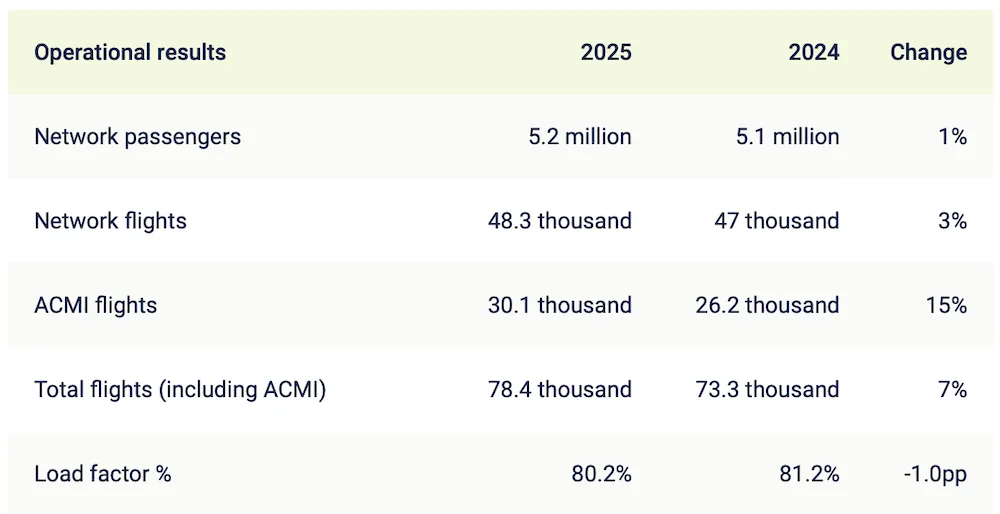
Passenger volumes also reached a new peak, with 5.2 million travelers carried across the airBaltic route network during the year, thus reflecting continued demand and the airline’s key role in providing connectivity from the Baltic region.
Follow Aeronews on Facebook, Twitter, LinkedIn, Bluesky and TikTok
From an operational perspective, in 2025 airBaltic performed 48.3 thousand scheduled flights, while ACMI activity increased by 15% year-on-year to 30.1 thousand flights. Total flights reached 78.4 thousand, reflecting improved fleet utilization and sustained demand across the airline’s operations.
ACMI and charter services remained an integral part of airBaltic’s business model, contributing to operational flexibility and revenue diversification, with charter operations totaling above 650 flights during the year. The load factor stood at 80.2%, representing a slight decrease of one percentage point compared to the previous year, while remaining at a stable level overall.
To support flight operations and long-term growth, airBaltic expanded its training and maintenance capabilities, by doubling simulator capacity with the addition of a new Airbus A220 full-flight simulator. Operational capacity was further supported by the launch of two new aircraft hangars and the opening of the Baltic Cargo Hub, one of the largest air cargo facilities in the Baltics.
Looking ahead, airBaltic expects its operational and commercial performance to strengthen in 2026, supported by improved fleet availability, the planned delivery of additional aircraft, and continued growth across both network and ACMI operations.
The introduction of Starlink high-speed onboard connectivity and further network expansion, including new routes and increased frequencies across the Baltic capitals, are expected to enhance customer experience and support revenue growth. Improving macroeconomic conditions in the Baltic region, together with continued cooperation with strategic partners, provide additional confidence in future demand development.