

If every one of the world’s approximately 8 billion people were to complete 60 calculations per minute — arithmetic problems, for example — and continue non-stop, it would take them 4 years to accomplish what Frontier can do in just one second.
Follow Aeronews on Facebook, Twitter, LinkedIn, TikTok and Instagram
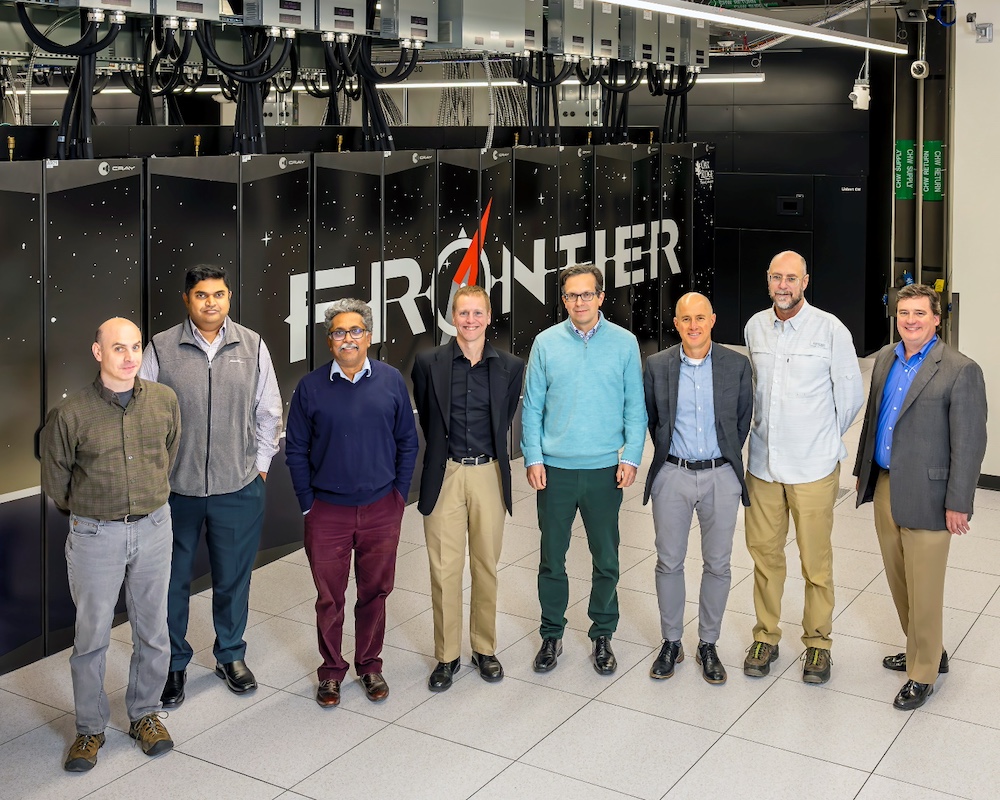
Operating since May 2022 at the U.S. Department of Energy’s Oak Ridge National Laboratory in Oak Ridge, Tennessee, the world’s fastest supercomputer can perform more than a quintillion (10 to the 18th power) calculations per second, making it the world’s first exascale machine. It’s billions upon billions of times quicker than the human mind, giving it the power to synthesize and analyze incredibly large quantities of data.
All this makes Frontier an invaluable tool for scientists investigating the most complex questions of our time. And it has been a game changer for GE Aerospace engineers racing to develop the revolutionary Open Fan engine architecture that promises to redefine the future of air travel.
Since 2023, when GE Aerospace became the first industrial user granted access to Frontier, they’ve been using it to model engine performance and noise levels. In the process, they’re gaining insights that extend beyond the project at hand.
The super-capable computer allows Trevor Wood, senior principal engineer at the GE Aerospace Research Center and his colleagues to simulate the full-scale Open Fan engine at actual flight conditions whereas smaller computers can handle only a reduced, scaled-down version. Frontier’s capabilities also allow GE Aerospace engineers to visualize the way air flows around components at a microscopic level. These studies help accurately predict how fan blades will perform in nearly any possible real-life situation, yielding information it would otherwise take scientists years to gather.
GE Aerospace’s Frontier-based projects support the CFM RISE (Revolutionary Innovation for Sustainable Engines) program, unveiled by GE Aerospace and Safran Aircraft Engines in 2021. The RISE program aims to develop technologies that will help enable a future aircraft engine to achieve at least 20% lower fuel consumption and 20% fewer CO2 emissions than today’s most efficient commercial engines.
“When it comes to sustainability, the industry has aggressive goals, including an ambition to achieve net zero by 2050,” says Wood. While the team is testing a variety of RISE program components on Frontier, “we’re running [many] simulations on the fan blade because it’s such a huge driver of net efficiency.”
Simulations pave the way for creating blades that optimize aerodynamic efficiency by reducing sources of energy loss. And they help the GE Aerospace team explore one of the most constantly challenging areas of science: the complex, chaotic flow of air known as turbulence.
Large-scale turbulence creates a bumpiness familiar to anyone who’s flown in a plane. But turbulent air currents are also present at the microscopic level, imperceptible to humans but causing friction, drag, and other issues that affect engine performance and efficiency. Unfortunately, the behavior of turbulent air is notoriously difficult to predict.
“You can’t see turbulence, but simulations can help us visualize it, so we can better understand it,” says Wood.
The level of detail Frontier provides is hard to fathom. “We are simulating air flow while moving forward in time in fractions of a second, getting a read on what the flow field looks like at a scale orders of magnitude less than the width of a human hair off the wall [of the fan blade],” explains Sriram Shankaran, consulting engineer for aerodynamic methods at GE Aerospace. “Turbulence is the last unsolved problem in classical physics. We’re not trying to solve it in a universal way; we’re instead finding ways to compute our way to the solutions we need.”