
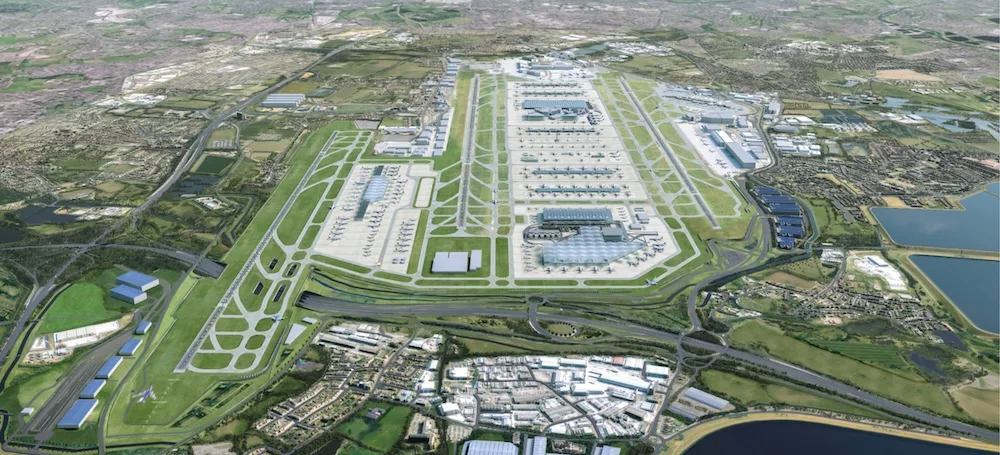
Heathrow has submitted its shovel-ready proposals for a 100% privately financed third runway, capable of flights taking off within a decade. An expanded Heathrow would give passengers more choice – at least 30 new daily routes, extra domestic connections and a better selection of flight times to the most popular destinations.
Follow Aeronews on Facebook, Twitter, LinkedIn, Bluesky and TikTok
Alongside more reliable journeys and cheaper fares through an expanded airline selection, terminals will be more spacious and accessible and flights quicker to take off, thanks to a once-in-a-generation redesign of the airfield.
Once completed, Heathrow’s plans would grow the UK economy by 0.43% GDP, add 50% capacity to the country’s most valuable trading port – already enabling more than £200bn of annual trade – while keeping its global competitive edge.
The blueprint submitted to Government today includes:
– A north-western runway up to 3,500m – a design that already has Parliamentary support
– Increased capacity to serve up to 756,000 flights and 150m passengers
– A brand-new terminal ‘T5X’, expanding Terminal 2 and three new satellite terminals
The investment consists of three main elements: £21bn for the new runway and airfield infrastructure (up from £14bn in 2018 due to construction inflation), £12bn for new terminal and stand capacity – the brand new T5X – and £15bn for modernising the current airport through expanding Terminal 2 and ultimately closing Terminal 3.
A third runway and supporting infrastructure can be ready within a decade, and the full investment across all terminals would take place over the coming decades. Heathrow’s proposals include more choice and capacity on public transport, such as enhanced rail capacity and walking and cycling routes, reducing local and environmental impacts.
A new road tunnel, plans for two dedicated parkways and improvements to the country’s busiest bus and coach station will make it easier than ever before to reach the airport. The airport is already ahead of target on its decarbonisation journey, cutting carbon from flights by around 10% since 2019, and carbon on the ground by 15% and has plans to ramp up further its world leadership on the use of Sustainable Aviation Fuel (SAF).
Heathrow’s noise footprint has reduced by 41% since 2006 and all air quality monitors around the airport are meeting limits. A third runway and redesigned airspace will give communities and passengers more certainty and reliability on flight paths.
The £49bn investment includes all aspects of the full expansion and modernisation of Heathrow and includes the rounding up of decimal places. Any cost comparison must take the following into account:
– The third runway £21bn, this includes the investment required to obtain consent, procure the land, prepare the land including M25 realignment and expand the airfield with the runway, taxiways and associated airside infrastructure. The previous figure of £14bn has risen due to construction inflation. This figure did not include the following two elements
– New terminal capacity £12bn, this includes the investment required to expand the airfield with aprons and stands connecting to the existing T5, construction of T5X and T5XN to support increased passengers, baggage systems, airside and landside infrastructure, car parks and connectivity enhancements. T5X would be a new second front door to the main T5 building, similar in size, with a large shared public transport interchange and public space between the two. T5XN would be a new satellite next to the new runway, connected by track transit
– Modernising current infrastructure £15bn, this includes a major upgrade to Terminal 2, with the delivery of two satellite piers, enabled by the phased closure of Terminal 3 and redevelopment of the Central Terminal Area. This is planned irrespective of a third runway but is included in the total DCO for practical reasons.
Due to rounding, these three elements total £49bn. Numbers at this stage are still subject to considerable uncertainty as with any other project of this size and complexity