
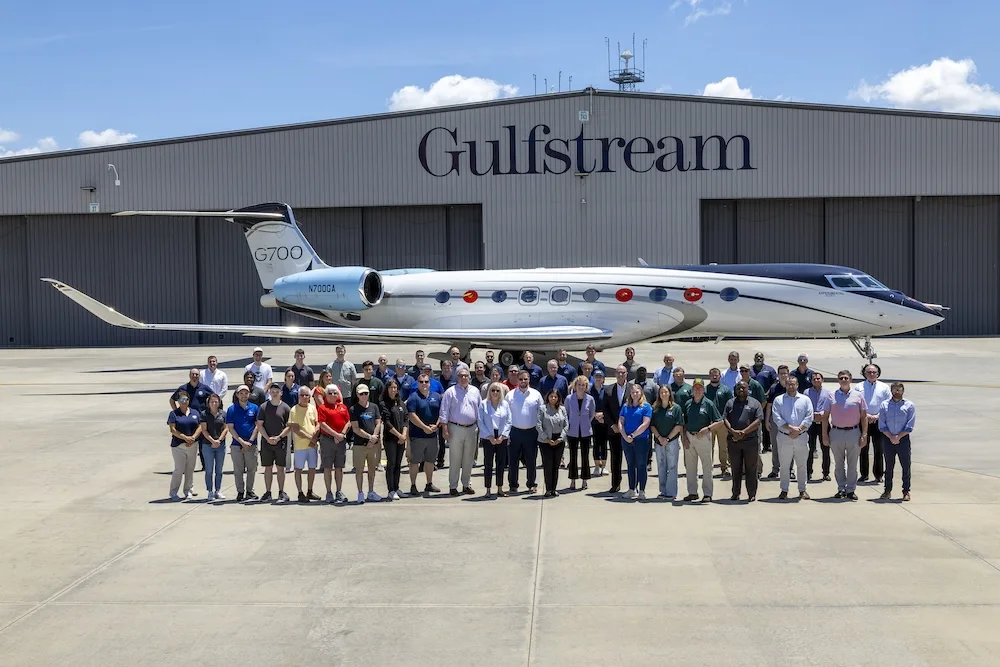
Gulfstream has become the first business aviation company to successfully complete a high-altitude flight test campaign demonstrating the potential for 100% neat sustainable aviation fuel (SAF) to reduce contrail-forming particle emissions at altitudes up to 50,000 feet.
Follow Aeronews on Facebook, Twitter, LinkedIn and TikTok
The campaign marks the first 100% SAF flight for the Gulfstream G800 and Pearl 700 engine. The aircraft was paired with a specially modified Gulfstream G700, transformed into a flying emissions measurement laboratory. Operating in close formation, the aircraft enabled researchers to capture precise, real-world measurements of particulate matter and contrail-forming atmospheric characteristics at higher altitudes than flown by most commercial airliners, yet typical for business aviation.
Conducted in collaboration with the Federal Aviation Administration’s (FAA) Center of Excellence (ASCENT), NASA, the German Aerospace Center (DLR), Missouri University of Science and Technology, Aerodyne Research, Rolls-Royce, Montana Renewables and World Fuel Services, the campaign was designed to isolate how fuel composition influences non-CO2 emissions, an area of increasing focus across science and industry.
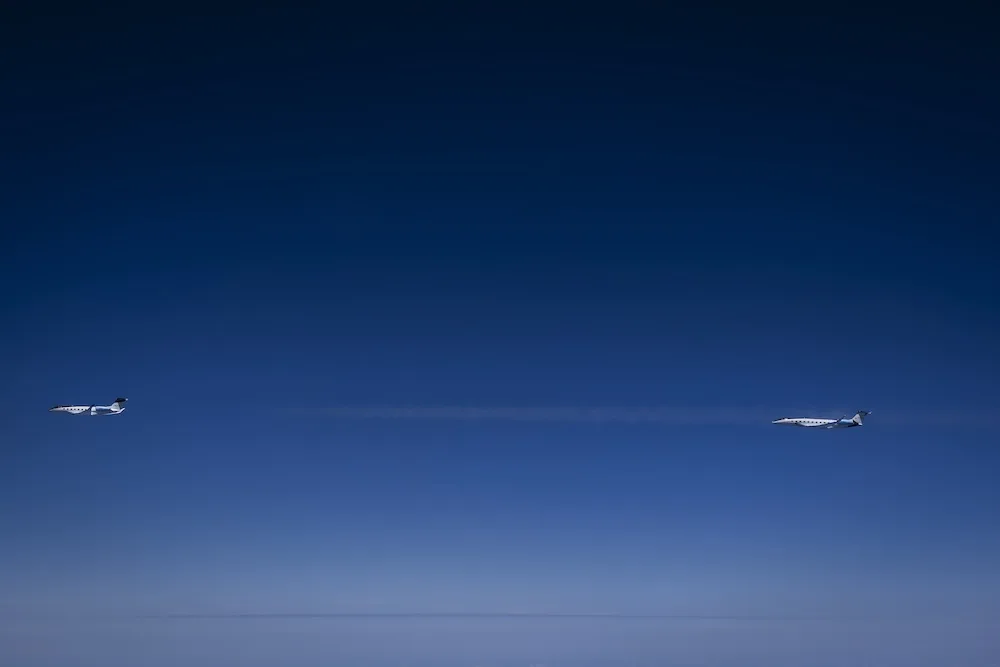
To accomplish this, the team compared conventional Jet A, low-sulfur Jet A and neat hydroprocessed esters and fatty acids (HEFA) SAF, which contains no sulfur or aromatics. Preliminary results suggest a significant measurable reduction in the particulate emissions that contribute to contrail formation when operating on neat SAF.
Delivering these results required months of preparation by Gulfstream’s engineering and flight test teams, including modifying the G700 cabin to integrate advanced in-flight emissions instrumentation. Pilots trained extensively in simulators to execute complex formation profiles needed to capture both near-field emissions and contrail evolution several miles in-trail.
This work builds on Gulfstream’s longstanding leadership in building a strong sustainable aviation future, including the industry’s first trans-Atlantic flight using SAF in one engine in 2011 and the industry’s first trans-Atlantic flight powered by 100% SAF in 2023. To date, Gulfstream aircraft have flown more than 3.5 million nautical miles on SAF blends.