
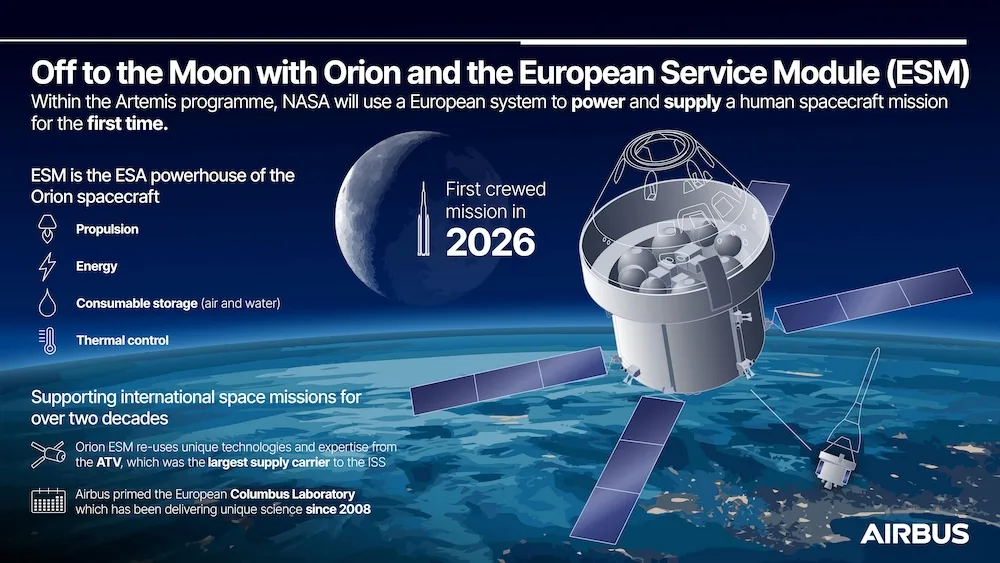
As the world prepared for the launch of Artemis II, the first crewed mission to the Moon in over 50 years, the Orion European Service Module (ESM-2) was fully integrated, fuelled, and “go” for flight.
Follow Aeronews on Facebook, Twitter, LinkedIn, Bluesky and TikTok
The ESM is built by Airbus on behalf of the European Space Agency (ESA). Functioning as the powerhouse of NASA’s Orion spacecraft, the ESM-2 provides propulsion, power, thermal control and the vital air and water needed for the four astronauts to survive in Space.
The mission is sending NASA astronauts Reid Wiseman, Victor Glover, Christina Koch, and Canadian Space Agency (CSA) astronaut Jeremy Hansen on a 10-day journey around the Moon. Unlike the uncrewed Artemis I test, this mission places human lives directly in the hands of European engineering.
At its farthest, Artemis II will be about 250,000 miles from Earth. NASA expects that on April 6, they will surpass Apollo 13’s record when it reached 248,655 miles from Earth.
“The transition from Artemis I to Artemis II is the shift from a test vehicle to a living space,” said Marc Steckling, Head of Earth Observation, Science and Space Exploration at Airbus. “When Reid Wiseman and his crew throttle up the ESM’s engines to leave Earth orbit, they are also trusting the work of hundreds of engineers across ten European nations to take them to the Moon and bring them home safely.”

The ‘heart and lungs’ of Orion
While Artemis I proved the structural integrity of the vehicle, Artemis II marks the debut of the ESM’s active life support capabilities.
Breathing and drinking: The ESM-2 carries 90 kg of oxygen and 240 kg of drinking water, which it will pump into the crew module to keep the astronauts alive.
Thermal Control: As the spacecraft faces the extreme temperature swings of deep space, the ESM’s active thermal control system will regulate the cabin temperature, keeping the crew comfortable.
Power Generation: The module’s signature four-bladed solar arrays will generate 11.2 kW of power – enough to supply the spacecraft and the new high-speed communication systems.
Propulsion: 33 engines onboard the ESM to provide thrust and propulsion to manoeuvre Orion to its destination.