
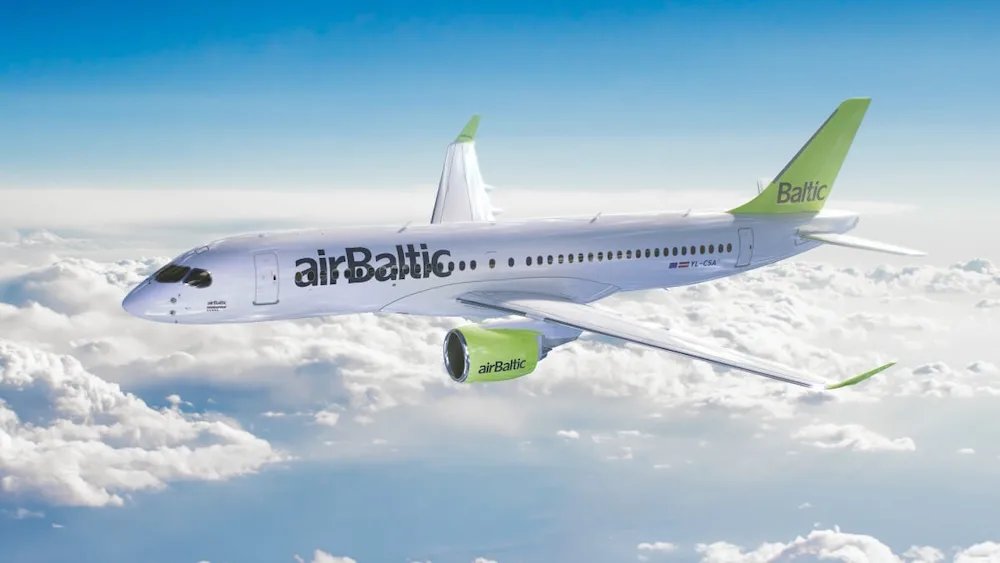
The plan combines a more focused network centred around Riga, a reduced all-Airbus A220-300 fleet, stronger year-round ACMI partnerships and improved operational efficiency. It is intended to create a more resilient business with improved financial sustainability.
Follow Aeronews on Facebook, Twitter, LinkedIn and TikTok
The business plan introduces a network strategy centred on Riga, Latvia as the airline’s primary hub. Rather than pursuing broad expansion, airBaltic will focus on deepening its presence in existing markets by increasing depth and frequency where demand and profitability are strongest. The company’s bases will continue to complement the network through selected point-to-point services, while tactical and seasonal flying will improve fleet utilisation throughout the year.
airBaltic expects to operate approximately 36 Airbus A220-300 aircraft by the end of 2026 (currently 54), with the fleet gradually increasing to around 40 aircraft by 2031. Despite the smaller fleet, scheduled capacity is expected to remain broadly stable through improved aircraft utilisation. Moreover, enhanced commercial partnerships with ACMI partners will enable more efficient year-round aircraft deployment while reducing seasonal volatility across the business.
Scheduled service Available Seat Kilometres (ASKs) are projected to decline from approximately 9.6 billion in 2026 to 8.7 billion in 2027, before gradually increasing to approximately 10.5 billion by 2031, reflecting a more focused network strategy centred on profitable growth.
ACMI partnerships
A strengthened commercial partnership with ACMI customers will support airBaltic’s return to profitability under the new model. Deploying capacity in a more balanced way during both the summer and winter seasons supports margins by materially reducing the company’s fixed-cost burden during the winter season, while mitigating the seasonality of the network business, diversifying the revenue base and providing greater flexibility to allocate aircraft according to market demand.
Through the combined fleet, network and operational initiatives, airBaltic is targeting approximately EUR 45 million in recurring annual benefits, primarily through operating cost reductions but also revenue opportunities. The revised plan prioritizes rigorous cost discipline alongside revenue growth to rebuild financial strength: improved margins and cash generation are expected to result from both more disciplined capacity deployment and a structurally lower cost base.
Financial outlook
Under the revised business plan, airBaltic expects revenue to reach approximately EUR 0.8 billion in 2027, increasing to EUR 0.9 billion in 2029 and EUR 1.0 billion by 2031. EBITDAR is projected to increase to approximately EUR 192 million in 2027, EUR 243 million in 2029 and EUR 300 million in 2031, representing an EBITDAR margin of approximately 25–29%.
airBaltic continues to operate as normal, and all scheduled flights are operating according to plan. The implementation of the business plan will not affect the airline’s day-to-day operations or the services provided to its passengers.