The change gives Boeing airline customers the option to carry more payload or fly longer routes. Air New Zealand, the 787-9 launch customer, will be among the first operators to use the iMTOW capability.
Follow Aeronews on Facebook, Twitter, LinkedIn, Bluesky and TikTok
The first jets built with the capability are now progressing through ticketing and delivery activities. The upgrade comes about 15 years after the Boeing 787 Dreamliner first entered service in 2011, with more than 1,250 deliveries completed worldwide and over 1 billion passengers flown to date.
Program leaders say iMTOW upgrades reflect airline feedback and ongoing product development. “We started this effort after airlines sent Boeing a clear message: they wanted greater flexibility,” said John Murphy, 787 chief project engineer. “Some wanted the 787-10 to fly longer missions; others wanted the 787-9 to carry additional payload with range trade-offs. Boeing designed a solution that delivers both.”
How it works
All 787-9 and 787-10 airplanes assembled as of December 2025 are structurally capable of the higher weight. Certified operating weight is designated per airplane and can affect airport fees and route planning. For those reasons, airlines can choose to activate the capability at delivery or later. Offering iMTOW as an option lets carriers match certified capability to their network economics.
The 787 family already provides up to 25% better fuel efficiency than the airplanes it typically replaces. The increased take-off weight preserves that efficiency while adding performance.
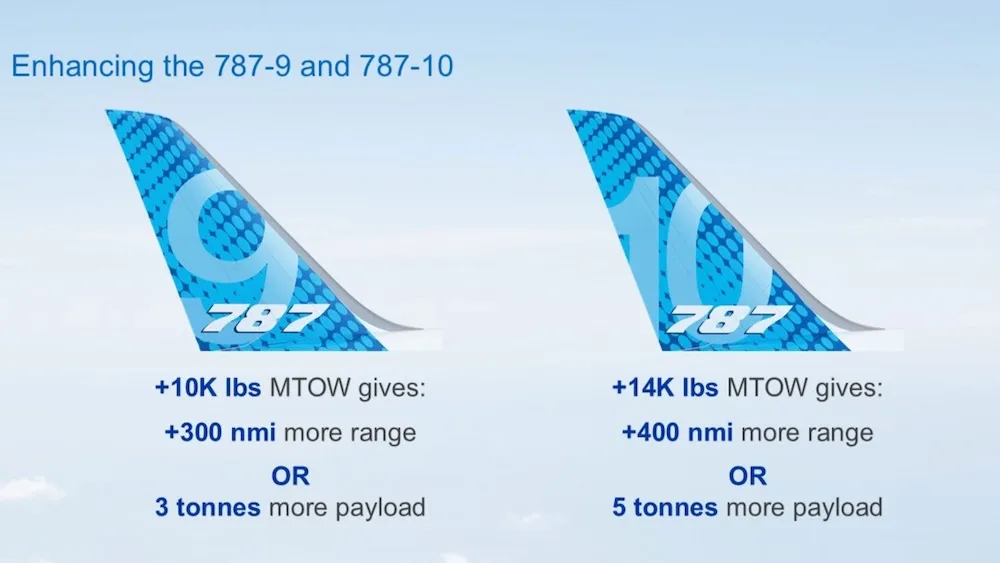
787-9: Roughly 10,000-pound (4,540-kilogram) increase enables about 3 metric tons of extra payload, or more than 300 nautical miles (560 kilometers) of additional range.
787-10: Roughly 14,000-pound (6,350-kilogram) increase enables about 5 metric tons of extra payload, or more than 400 nautical miles (740 kilometers) of additional range.