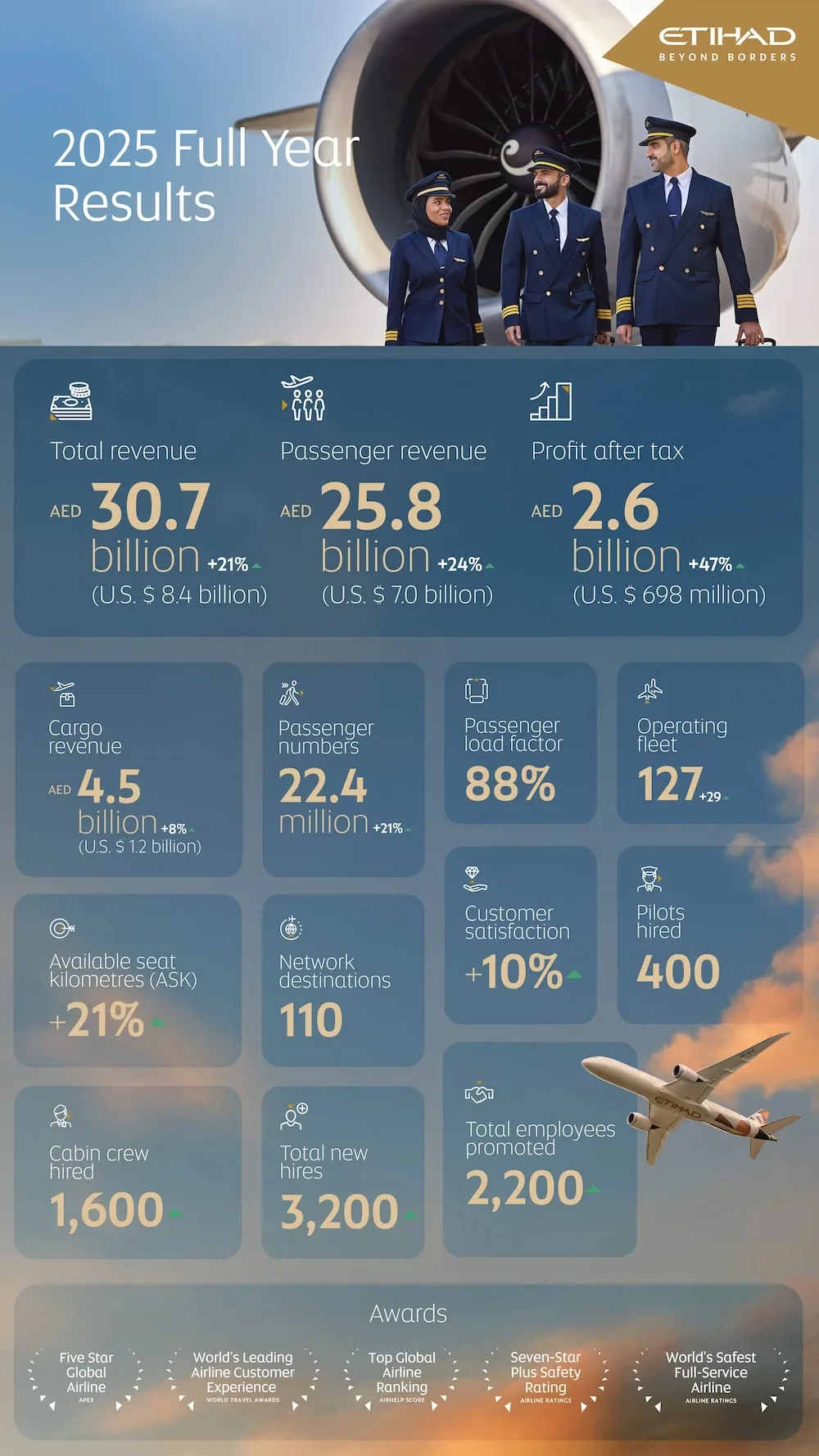
Etihad reported its strongest full-year financial and operational performance on record, marking its 4th consecutive year of profitability. The result reflects a year of rapid network and fleet expansion, strong demand across global markets, and the airline’s ability to scale its operations.
Follow Aeronews on Facebook, Twitter, LinkedIn, Bluesky and TikTok
Financial and operational highlights
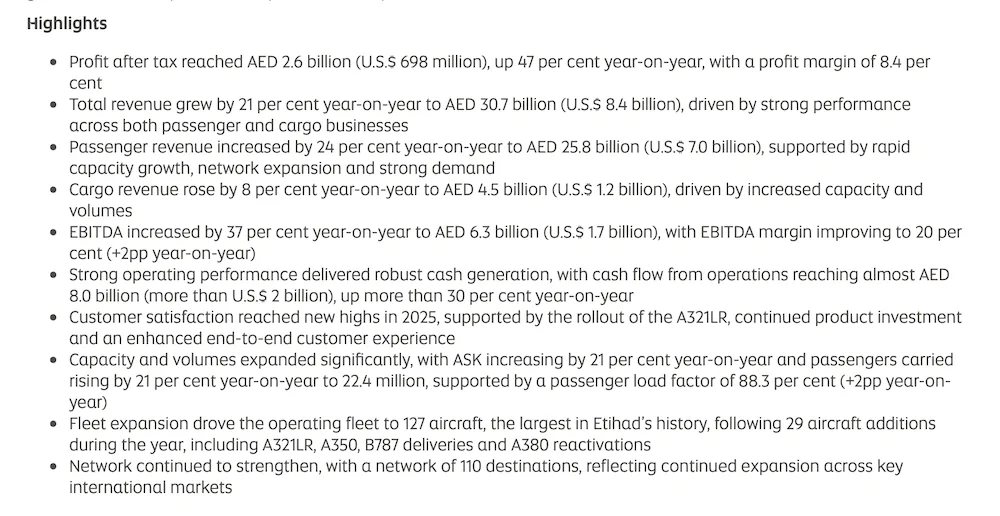
Etihad carried 22.4 million passengers, supported by a 21 per cent capacity increase year-on-year, with available seat kilometres (ASK) reaching 111.5 billion. Demand remained strong across the network, with the passenger load factor rising to 88.3 per cent (+2pp year-on-year), demonstrating the execution capability of Etihad’s teams.
This growth translated into a strong revenue performance, with total revenue increasing by 21 per cent year-on-year to AED 30.7 billion (U.S. $ 8.4 billion), driven by expansion across both passenger and cargo businesses.
Passenger revenue rose by 24 per cent year-on-year to AED 25.8 billion (U.S. $ 7.0 billion), reflecting increased capacity, sustained demand, improved load factor and stronger yields.
Cargo revenue increased by 8 per cent to AED 4.5 billion (U.S. $ 1.2 billion), supported by higher capacity and volumes, with cargo volumes rising 9 per cent to more than 700 thousand leg tonnes. Growth in the passenger fleet also supported cargo performance through increased belly-hold capacity, reinforcing Etihad’s integrated passenger and cargo operating model. As a result of this expanded capacity and its joint venture with SF Express, Etihad became the largest cargo operator between mainland China and the Middle East, operating over 100 monthly cargo services.
Operating performance strengthened further, with EBITDA increasing by 37 per cent year-on-year to AED 6.3 billion (U.S. $ 1.7 billion), translating into an EBITDA margin of 20 per cent (+2pp year-on-year). The strong operating performance and unit cost discipline resulted in a profit after tax of AED 2.6 billion (U.S. $ 698 million), up 47 per cent year-on-year, with profit margin improving to 8.4 per cent (+1.5pp year-on-year). This is equivalent to more than double the industry average net profit margin of 3.9 per cent, according to IATA’s December 2025 estimates.
Supporting UAE and Abu Dhabi
Etihad continued to grow point-to-point and stopover traffic to Abu Dhabi in 2025, with point-to-point traffic increasing by 900 thousand passengers year-on-year to 5.5 million, up from 4.6 million in 2024. The airline’s stopover programme welcomed 170,000 visitors, more than double the 80,000 recorded in 2024. This growth further strengthens Etihad’s contribution to Abu Dhabi’s tourism sector, driving increased international arrivals and overnight stays through network expansion.
Etihad’s growth in 2025 accounted for approximately 50 per cent of total passenger growth in the UAE, based on projected airline traffic performance across the country, underlining the airline’s central role in supporting Abu Dhabi’s tourism, trade and broader economic ambitions.
This contribution was driven by the largest expansion year in Etihad’s history. With 29 aircraft added during the year, the operating fleet grew to 127 aircraft, enabling increased frequency, expanded capacity and a broader global reach to and from Abu Dhabi.
Supported by this fleet growth, Etihad increased its network from 94 to 110 destinations, while total landings rose from 90 thousand to more than 105 thousand. Expansion focused on opening new international markets and increasing direct access to Abu Dhabi across Europe, Asia, Africa and North America.
New routes were launched from key inbound source markets including Atlanta, Prague, Warsaw, Addis Ababa, Phnom Penh, Hanoi and Hong Kong, further enhancing Abu Dhabi’s global connectivity and visitor flows.
 Guest experience
Throughout 2025, Etihad continued to elevate the guest experience alongside rapid network and fleet expansion, ensuring that growth was delivered without compromising service quality or product consistency. Investment across First and Business cabins included fully lie-flat seating on the A321LR, enhanced onboard dining, upgraded amenity kits, and refreshed lounge and ground experiences, supporting a consistent premium offering as capacity scaled.
On the ground, the airline expanded its First proposition to more routes, introducing personalised concierge services, private chauffeur transfers, dedicated check-in and premium airport experiences, reinforcing a seamless door-to-door journey.
These investments were complemented by the February brand refresh and launch of a new website and mobile app, enhancing digital self-service and the end-to-end customer journey. As a result, overall Net Promoter Score increased by 10 per cent year-on-year, with improvements across all cabins and major touchpoints, reflecting measurable improvements in comfort, reliability and digital engagement.
Employees
Etihad continued to invest in its people throughout 2025, supporting growth across both frontline and corporate roles while strengthening leadership capability and operational depth. During the year, the airline welcomed more than 3,200 new joiners and promoted around 2,200 employees.
Frontline hiring remained a priority, with around 1,600 cabin crew and almost 400 pilots joining the airline in 2025, supporting capacity growth while maintaining service quality and operational resilience. At the same time, Etihad continued to recognise and develop talent internally, delivering around 1,500 cabin crew promotions and nearly 150 pilot promotions during the year.
Etihad’s workforce in 2025 represented 152 nationalities, reflecting the airline’s diverse, global operating footprint. Alongside this, the airline maintained a strong focus on UAE National talent development, including cadet pilot intakes and future leadership programmes, ensuring Emirati talent continues to play a growing role in Etihad’s long-term success.
Alongside this, Etihad also took important steps in 2025 to support its next phase of growth through major aircraft orders announced in May and November, enhancing its long-term fleet pipeline and providing greater flexibility to support future growth, network expansion and product development.